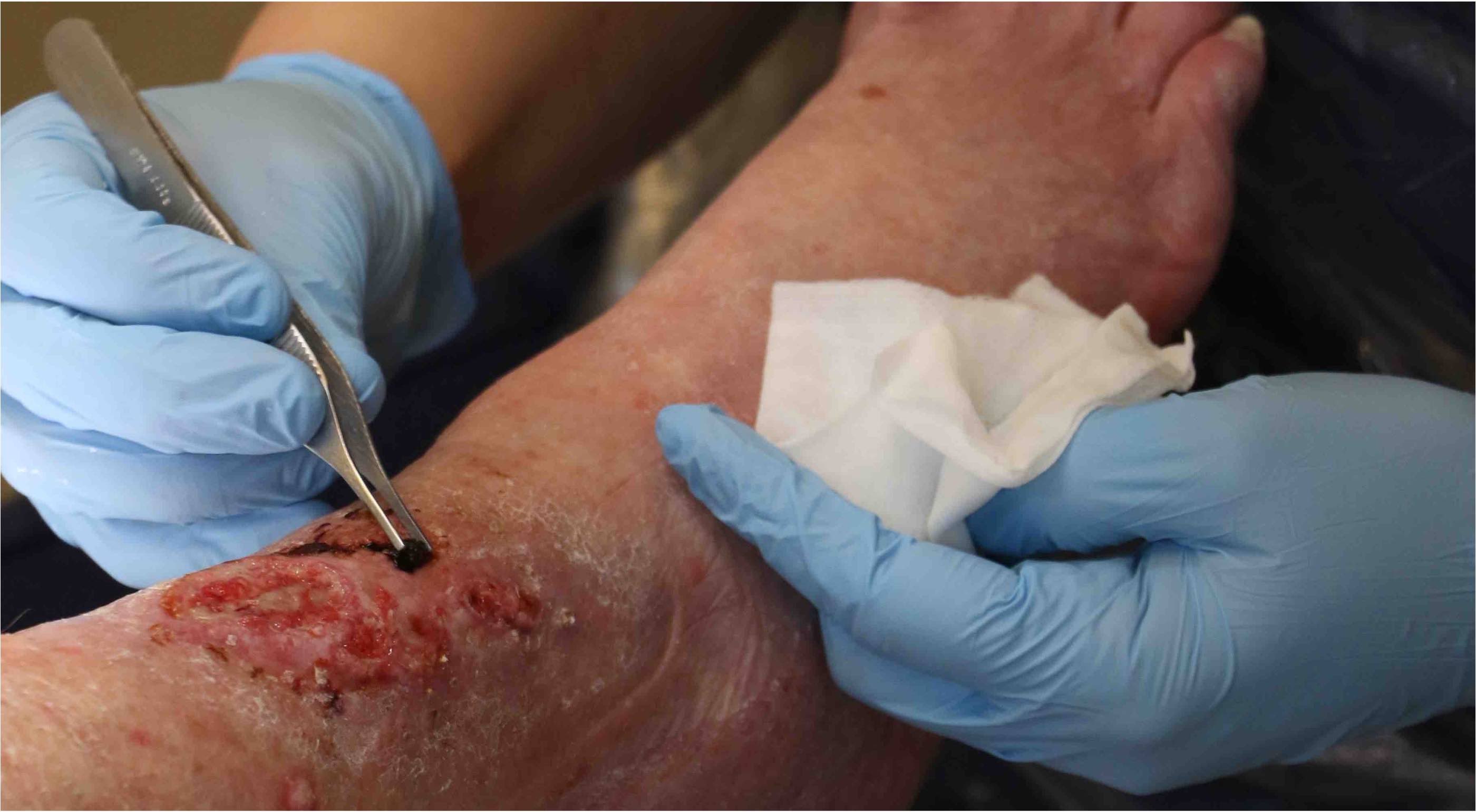
”After years of research we suddenly realised how to combine our findings. It was a eureka moment.”

How Amferia's antibacterial peptide technology can revolutionise wound care

Antibacterial peptide hydrogel that is safe to the body

Antibacterial peptide hydrogel that is safe to the body

How it works:

For decades, we’ve known that antibacterial peptides are potent bacteria killing agents. Peptides carry a positive electrostatic charge, which naturally attracts the negative charge bacteria carry. Once attached, the knife-like structure of peptides puncture bacterial membranes, killing the cells.  

What hasn’t been known—until now—is how to protect vulnerable parts of the peptide from natural enzymes in the human body. In nature, peptides are fragile molecules. Enzymes can destroy them in seconds. To be effective antibacterial agents, peptides need protection.  

To be antibacterial, peptides need protection  

Amferia solves that problem with an innovative, patented amphiphilic hydrogel platform that binds the peptides in a solid gel, and protecting them.

Amferia’s hydrogel stabilizes and protects the peptides in biological environments. Amferia harnesses peptides in a safe, stable, non-toxic and clinically applicable form, allowing them to be antibacterial without harming anything else in the body.

Amferia’s proprietary antibacterial peptide technology rapidly reduce broad spectrum of microbes on the dressing by 99.99% upon contact. 

The material is entirely non-toxic to the human and animal body. 

Amferia’s approach

  • 1.  Antibacterial peptide binds and physically disrupts bacteria
  • 2. Highly potent and targets only bacteria
  • 3. Completely harmless to human cells
  • 4. Does not release any active substances from the hydrogel

Using antibacterial peptides — mimicking the immune system

The science:

Derived from the mammalian immune system, antibacterial peptides are powerful molecules that can rapidly and selectively kill bacteria, fungi and various other pathogenic microbes.

Until today, antibacterial peptides have had poor stability

These peptides have been present in mammals for millions of years and have a unique way of inhibiting microbial growth by rapidly disrupting the microbe's cell membrane through something called electrostatic and amphiphilic interaction. You can think of peptides as a highly specialised soap-like molecule designed to kill bacterial cells by ripping off their skin. 

Antibacterial peptides carry a net-positive charge and a molecular structure that includes hydrophobic and hydrophilic characteristics. These two factors allow peptides to attract bacterial cells—which carry a net-negative charge and are also amphiphilic—and bind to them, before puncturing their membrane and killing the cell.

Until today, antibacterial peptides have had poor stability. In the past, their fragility has made antimicrobial peptides challenging for clinical applications. High doses of antimicrobial peptides were needed, which increased costs and prolonged the time-to-market.

As a result, past efforts to develop market-ready products featuring this valuable antimicrobial technology have faced substantial hurdles.

Amferia has solved this problem by implementing a scientifically robust approach that covalently and permanently bind antibacterial peptides to the surface of a soft, ordered and amphiphilic hydrogel pad.

These permanent bonds protect the vulnerable portion of the peptide molecule and fix them in place, while leaving their antibacterial mechanism free to inhibit bacterial growth. They also ensure no peptides leak into the wound. Antibacterial peptides fixed to an underlying hydrogel pad allowed Amferia to develop a safe, efficient and cost-effective design for a wound dressing.  

Amferia has solved this problem by permanently binding the peptides to an amphiphilic hydrogel

This design provides the needed balance between stability and activity.

The end-product is a singular material that does not leach or release any peptides or substances into the body, but rather acts locally as a medical device.

Previous antimicrobial peptide technologies utilize peptides in their pristine form, which renders them inactive in a few minutes. Amferia’s innovation enables the bound peptides to remain stable and active for up to five days. Current testing indicates the product we’re developing for wound care will be shelf-stable for up to eighteen months.

Read about our first product using the technology >

Years of research yield a breakthrough innovation

Technology:

Amferia’s technology is born out of years of research performed at Chalmers University of Technology. The concept behind Amferia’s antibacterial properties are enabled by a new material known as antibacterial peptide-hydrogel with amphiphilic structure.

An amphiphilic substance is one that displays both hydrophilic and hydrophobic characteristics. Comprised of about 70% water, the hydrogel is soft and flexible, making it useful for numerous medical applications.

Amferia’s technology is based on a new material known as antibacterial peptide-hydrogel with amphiphilic structure

The surface of amphiphilic hydrogel consists of antibacterial peptides that are covalently and permanently bound to the hydrogels amphiphilic structure—forming a single material. The material interacts with bacterial cells and, disrupts the bacterial cell wall rapidly, effectively killing the bacteria.

Testing proves that the antibacterial peptide-hydrogel does not release any substances into the wound or the environment. This material can potentially be configured into antimicrobial products ranging from wound care dressings to antiseptic sprays to mechanically durable devices such as catheters and implants.  

To date, analysis confirms that Amferia amphiphilic hydrogel reduces microbial growth by 99.99% which includes gram-negative and gram-positive bacteria.

It has been proven to be non-toxic to the body as per ISO 10993 biocompatibility evaluations, namely acute toxicity, cytotoxicity, skin sensitisation & irritation, implantation and material mediated pyrogenicity. 

Amferia's first product for human wound care has been developed for easy applicability and functionality. More products and broader applications are in the pipeline.

Read about possible applications of Amferia's innovation >

How this platform technology can transform medical devices

Applications beyond wound care:

‍

Pre-surgery and insertion sites

Another potential application for Amferia hydrogel comes in the form of a patch that can protect the skin from bacteria before a surgical procedure.

Adhering a protective hydrogel patch to the incision site prior to surgery provides protection. In emergency wards, where patients may be waiting in a non-sterile environment prior to surgery, the Amferia hydrogel patch can reduce complications and potentially save lives.

Antibacterial spray and gels for debridement

The flexible nature of our hydrogel platform allows us to apply the patented bacteria-killing hydrogel in many forms—including an aerosol spray or gel for efficient debridement. Small particles of the antimicrobial hydrogel can be dispersed through an aerosol to cover broader areas of the skin and wounds. A pipeline product being developed at Amferia is a spray that can be applied directly to wounds or skin, especially deep wounds with high bacterial presence.

The spray system enables the same antimicrobial mode of action as the wound dressing while ensuring high surface area, which will enable efficient debridement.

This scientific basis for this product has been evaluated scientifically and published in a peer-reviewed journal.

Device coatings

Short-term implantable medical devices such as urinary catheters are widely used in hospitals and nursing homes to relieve urinary retention and incontinence.

In these types of medical devices, the most common and life-threatening complication is catheter associated urinary tract infections (CAUTI), which affect over 10 million patients every year with high economic cost and patient suffering. Antimicrobial resistance has made it difficult to treat CAUTI via conventional antibiotics.

With an increasingly ageing population and rising costs to treat CAUTIs, a strong need exists for innovative anti-bacterial catheters that prevent bacterial colonisation on the catheter walls.

In collaboration with Chalmers University of Technology, Amferia has begun ongoing research into enabling our technology as a whole catheter or as coatings to existing catheters. The base technology, amphiphilic antimicrobial hydrogel may be developed into tough silicone-like materials or can be tailored as coatings to silicone surfaces. Both these prospects are being tested today as proof-of-concepts and published in scientific articles.  

‍

Amferia’s technology verified in scientific papers

Scientific evidence:

The antimicrobial efficacy of Amferia’s technology platform and its safety in lab and animal studies have been verified in numerous pre-clinical studies published in peer-reviewed scientific journals.

The studies describe evidence of Amferia’s technology through fluorescence microscopy against multiple strains of bacteria, including resistant bacteria. An animal infection study demonstrates the real-time effectiveness of Amferia hydrogel in eradicating bacteria from a wound. 

In 2022, Amferia’s technology platform was verified in a new form for potential spray-based applications. The base technology was reformulated as small particles that can be sprayed for applications in deep wounds. The results demonstrated excellent reduction of the broad bacterial bio burden including resistant bacteria up to 4 log reduction (or 99.99%) bacterial colonies. This study and others are now published in peer-reviewed scientific journals as listed below. 

Pre-clinical studies in peer-reviewed scientific journals

The Recent UN Report on Antibiotic Resistance

May 3, 2019

The United Nations appointed Interagency Coordination Group on Antimicrobial Resistance (IACG) has presented its report on Recommendations to Combat Antimicrobial Resistance (AMR). It is clear from the report that AMR is a global and complex threat that needs to be addressed with extreme urgency and with care. Consistent, coordinated and conscious actions are demanded, especially from the World Goverments, Academia, Public, Healthcare-Industry and  Agriculture. A world where bacterial infections cannot be fought efficiently is a world of perils.

Here is an excerpt from the IACG report.

“The challenges of antimicrobial resistance are complex and multifaceted, but they are not insurmountable. Implementation of the recommendations in this report will help to save millions of lives, preserve antimicrobials for generations to come and secure the future from drug-resistant diseases.

But there is no time to wait.”

-IACG Report, April 29, 2019

Do take a minute and read the summary of this important report (English, pdf 653 kb)

Amferia featured in Göteborgs-Posten

February 8, 2019

New patch from Gothenburg kills bacteria in wounds. Read to know more

Amferia wins the Swedbank Rivstart 2018

February 7, 2019

Amferia is proud to become the winners of the annual entrepreneur competition hosted by Swedbank, Rivstart. From over 1825 applications, Amferia finished on top!

Amferia wins the Venture Day 2018, hosted by Chalmers Ventures

November 28, 2018

Amferia is proud to be named winners of the annual Pitch competition hosted by Chalmers Ventures.

Thank you! Your message has been received. Talk to you soon!
Oh no! Something went wrong while submitting the form. Please try again.